

Most serious philatelists will know that a single “Inverted Jenny” sold for $977 500 in 2007. I’m not sure how many people know the actual story behind 100 of these stamps, so I thought I’d briefly summarise the story I read.
In May 1918 William Robey, a young Washington stamp collector walked over to the New York Avenue post office as a new stamp had gone on sale the previous day and he was hoping that he would perhaps buy some of the stamps. Being somewhat of an amateur connoisseur, he knew that the design of the stamp needed two colours, carmine for the frame and deep blue for the biplane. According to the technology at the time, this meant that the stamp would have to be fed through the press twice. Many knowledgeable stamp collectors knew that there was a chance for somebody to feed the sheet in the wrong way, which meant that the stamps would be valuable because of the error.
Robey walked into the Post Office and asked for 100 of the Curtiss JN-4 biplane stamps. Every stamp on the sheet had the biplane flying belly-up. The clerk who served him had never seen a biplane, so he did not know the difference. Once Robey had purchased the stamps, he mentioned the error. Soon after he arrived back at work, postal inspectors visited him, talked to his wife at home and generally tried to get the stamps back. He had paid the face value of $24. However there was no legal basis for them to demand the return of the sheet and Robey understanding the situation, was not going to return the sheet. For a week he and his wife slept badly with the stamps hidden under his bed. He decided to go to Philadelphia to a stamp dealer named Eugene Klein. He walked out with a certified cheque for $15000, quite a profit for an amateur stamp collector. His idea meant that he was able to purchase a car and a house.
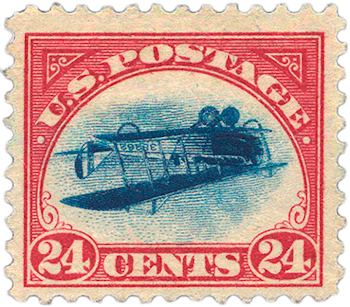
The dealer sold the sheet to Colonel Edward Green who knew a thing or two about stamps. He divided up the sheet, pencilling a position number on the back of each stamp then handed them out amongst his friends. For this reason nobody talks about the Inverted Jenny sheet, but they talk about Position 49, or 76 or whatever. Ethel McCoy owned numbers 65, 66, 75 and 76 as a block, bought in 1936 for $16000. In 1955 she lent it to the American Philatelic Society. Somebody cut through the exhibition case and walked off with it. During the next 20 years, two of the stamps were recovered. Then in 2016 Position 76 surfaced when a young British man took it to a New York Auction House to sell. He had inherited it from his grandfather. After intense investigation, the FBI and the Manhatten US Attorney’s office returned the stamp to the American Philatelic Research Library.
Position 49 sat in a family’s bank vault for 100 years, never hinged or exposed to light. In November 2023 four bidders pushed the total to $1.7 million.
I really hope you enjoyed this background story on the Inverted Jenny.
Leave a Reply